Showing posts with label shuttering. Show all posts

Monday, 21 December 2015

Winter Waffle (A Sense of Solstice)

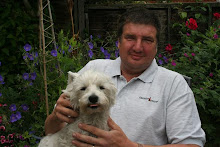
I quite like this shot of myself and 3 dogs, which Lizzie took in
the monochrome mode on her phone. 
The 21st December, the Winter Solstice is probably now my absolute favourite single day in the calendar. This is probably because in this life 'over here' we spend so much time out of doors and the weather, the day length and the dark evenings matter more - when I was in Kent I'd be up at just gone 04:00 but then work all day inside a huge chilled warehouse with air-con offices and it didn't matter a hoot what the weather was doing outside. You would only meet it when running from covered reception area to your car across the car-park top storey.

I am on Christmas cake duties this
year. Here the cake gets its marzipan.
Now the 21st is the day on which the days stop getting shorter and start to get longer, the evenings brighter and the Springtime 'officially' closer. It is a definite turn-around in fortunes when all manner of aspects of life stop getting 'worse' and start to improve. Lately I have made it the day by which I make sure all the killing, the livestock harvest is done so that mentally I can now think of the current members of the menagerie as our 'fighting weight' from which we will start to build again for the new season. There are one or two more animals to finish, including our June-born lamb Dylan but we will get well through this season before we look at him. I can do the 22nd, 23rd, 24th and 25th, and so on, on a rising, creative trajectory; we are cooking meals, creating food and preparing for Christmas, making things rather than ending lives and 'destroying' or finishing things. Just me being sentimental perhaps.

The  final turkey 'harvest' gets it in the neck. 
This re-start has, this year, added extra facets. This year we got into turkeys which are probably the epitome of harvesting at the Solstice. I killed our last poult this morning and we had her plucked and 'dressed' in time for Vendor Anna to collect her at lunchtime. This one was unusual in that Anna only wanted a 'crown' (the breasts, sternum and underlying ribs) so we have a rather unusual looking breastless carcass in the freezer which we may try to roast spine-uppermost on a bed of spuds, parsnips etc at some stage. Luckily we are both partial to the red meat.

Spatchcocked young Silver Brahma rooster. 
Those roosters I described in the last post turn out to be a breed called "Silver Brahma". One of them was more than a year old and seemed very tough so he went for stock, but one of the young ones got spatchcocked and roasted last night and, despite his 'scrawny' looks, turned out to be a revelation in terms of being meaty enough to feed 2 of us with left overs and having a flavour up there alongside the Hubbard meat birds we do each summer.

Liz coming to of a morning armed with Kindle,
 cat, onesie and the red flame of a fire in the
range
From my own point of view (I can only speak for myself here) I am also including the unexpectedly solid closure I got from the Theo funeral - my Theo era ended pre Solstice and I am now able to start the post-Theo synchronised with this turning point in the year. Down at the Sligo house-build we have also pretty much done with demolition, so the post-Sostice jobs are mainly going to be building and creating. We do actually have a chimney to pull down -  it was central to the old roof ridge but the new roof will sit back a couple of feet and be a tiny bit higher, so we need to create a new stack on that new line.

15 bales of straw for JD's cattle. 
We have been getting into this buildering with the new block-walls at the back of the house and, most recently, what is known as a 'ring beam'. I had not heard of this, but it is a continuously poured beam of concrete reinforced with steel bars (rebar) running all around the tops of your walls at roof height. You create wooden shuttering up from the outside and inside of the walls and heft buckets of wet concrete up ladders to pour into the channel you created. Loads of fun. Tiring, too!

A tree in the nick of time.
It has, though, been an unusually 'close to the wire' Christmas. It is the 21st today and we have a long list of things not yet done or only just done what with delays related to Liz now working, Liz heading for Silverwood land to child-mind while the adults headed for the UK, and the funeral. Things like buying the tree and decorating it, we like to do as a couple, so it was not as if I could have nipped off, bagged our tree and presented it to Liz on her return 'ta-daaaa!' So it was not till Sunday that we bought the thing and tonight we put it up. This was almost too close - Supervalue where we buy the tree had started with hundreds back in early December but by now they only had 4 left. We were lucky to find a decent one among them. Today, too, I have been marzipanning the cake and Liz has been doing Domestic Goddess. We have nipped out with the trailer for 15 bales of straw for some nearby cattle - they have the 'all is safely gathered in' feeling too. We may, between us all, actually be ready on the 25th to enjoy the day. I hope you are too. Now, where's that ruby port?

Tuesday, 16 April 2013

Concealed Shoes

Well! You live and learn! Today a fascinating story about a subject of which we had no idea till today. Hiding shoes in buildings, in walls, up chimneys and so on as a lucky charm, historically. It's a well known 'thing' apparently, but had passed us by.

The mighty winds of Sunday night and Monday, we discovered to our horror, had slightly lifted the Tígín roof in presumably a particularly strong gust. All these old buildings are not particularly well put together and the roof of this one must be a good 30-40 years old so that the timbers are quite rotten and the tin fairly rusty. The concrete and stone walls are solid enough to the top (gutter height) but the roof is then put on, seemingly without it being fixed down. The angle under the lower ends of each strip of corrugated, seems to be loosely filled with rubble before loose concrete is thrown into the gap from inside the building presumably to try to hold the loose rubble together and maybe 'glue' down the lowest horizontal as some kind of attempted 'wall plate'. The roof is then held down by pouring concrete over the ends of the roof at the gables, first creating a wooden box of shuttering to take the concrete while it sets.

Our winds had lifted the 'wall plate' half way along the wall and a loose stone had rolled into the gap, preventing the roof from falling back into place when the gust finished. We spotted that the corrugated seemed to be well proud of the guttering. The 'repair' was fairly simple, I just had to poke the loose stone back up out of the way and the roof could sag back onto its wall BUT it as in doing this poking, I spotted a small child's boot up among the rubble on top of the wall.

The shoe is 6 and three quarters inches long and 2 and three quarters inches wide and is of obviously 'stout' agricultural construction with several layers of leather, and most of its nails still there but blown and rusty. Fascinated, I winkled it out to show Liz, but we both then had the horrors in case this was some kind of family bereavement / memorial thing and decided not to use this in this blog or to photograph it.

However, Liz then went a-Googling on the internet using "Shoes found in walls" in the search engine and quickly discovered that this is actually a well known and wide spread cultural and building trades thing, to conceal a single child's-size shoe in your building works as a good luck token and there are whole museum databases and sections on which to record your finds. Northampton Museum in the UK and The Irish National Museum both ask for details.

One website at

http://northamptonmuseums.wordpress.com/2012/06/19/concealed-shoes/

had more.


  • "People often hid old boots and shoes," they report, "in chimneys and walls to bring good luck to their houses and to ward off evil spirits.


  • The shoes are always worn out.
  • Very often there is only one shoe.
  • Many of the shoes are for children.
  • The shoes were often put in place when building work was being done to the house.
  • It may be that if the workmen found a shoe they replaced it with a new offering, or put the old shoe back together with a new one?
  • No one knows when and how this habit began.
  • The earliest shoes we know of were put in place about 1500.
  • Shoes seem to have had a special significance.
  • A shoe is the only item of clothing which takes on the shape of the person wearing it.
  • A single worn shoe was hidden so that a malevolent spirit could not steal it and  take away the protection the shoe gave. 
Today people renovating old buildings sometimes come across ‘concealed shoes’.  The finds are very important because they show us what ordinary people were wearing on their feet hundreds of years ago. 
We keep a concealed shoe index here at the museum
At the moment the index stands at approximately 1,900 entries from all over the U.K and also records concealed shoe finds in North America, Canada, and a number of countries in Europe including France, Spain and Poland".

We will report our shoe to both Museums and have carefully replaced it in the top of the wall.

Interestingly, this is not the first leather item I have found, so I wonder whether this is a more general farm 'thing'. In the chicken house roof I found stashed a leather over-reach boot. These boots are fitted to horses' rear hooves where the horse has a tendency to bring his back foot so far forward in his stride that it can clout his front leg, which can be a problem on shod horses. 

Also, by coincidence, I was walking the dogs today and was greeted by a near-neighbour in a van who I had not met before. He introduced himself (We'll call him Brian the Roofer) and we chatted away a while before he told me that he was a roofer. A ha! said I and told him my story of the poor construction, rotten timbers, loose rubble and roof trying to get airborne. I invited him to drop by in passing and take a look and give me a quote on replacing the rooves of both the Tígín and the chicken house, which we will surely need to do at some stage, all be it hopefully not THAT soon!

Sunday, 12 February 2012

Wednesday Drama


This new floors job is not without its dramas as you can see from these pictures. When the joists were being pulled out of the spare bedroom floor (dining room ceiling) it quickly became apparent that the masonry in which they were sitting was not up to much. Look at the second picture down. You can see that the blocks of in-fill (generally stones and old cement) between joists are not held up by much and the lintel across the top of the window is just a lump of rotten old wood. When anyone stands looking out at the front garden, there was only this dodgy structure between them and a rocky head-ache, or worse.

Dad and Sparks were very worried that the whole lot would cave in, leaving one big hole where top and bottom windows and the bit between used to be, the lovely new windows smashed to bits in the collapse. Luckily these walls are 50 cms thick and have both an inner and an outside lintel and the outside ones were, at least, proper long beams of blue-stone, solid as the proverbial rock.

The boys had to move fast but carefully to ease out the remaining joists and lift out any stone which had already come free and was no longer holding anything up.New joists were then measured and cut to length and slotted carefully in to the solid wall either side of the dodgy bit and even more carefully across the top of the questionable lintel. A pit-prop arrangement was then made out of good timber to hold the ones across the window up into their pockets with bits of slate used to take up any slack. This was cemented in as best they could to stop movement.

Then the old dodgy lintel could be cut through and lifted out. It turned out to be made up of 2 very weak looking bits of former window-frame wood. With that gone the boys could bridge the gap with 2, 4-inch wide, 4 foot, reinforced concrete lintels. Sparks built a wooden shuttering around these so that concrete could be poured in all around and under the joists and through the loose inner side of the wall, all the way 'forwards' till it slopped around the inner surface of the good outer wall binding the whole thickness of the wall together. Now nothing was going to go anywhere. 2 days later the shuttering was prized off to reveal the solid, no-messing, structure and the joists could be finished and the floor boards laid without the risk of hammering and moving about setting off an avalanche. Today's first picture is of the window fixed.

The front door was simpler. No concrete pour was needed. The pit-prop arrangment was holding up the new joists here, too. The old soft baulk of timber was lifted out and a 6 inch wide, 5 foot concrete lintel slotted in, on top of which cement and blocks were built brick-layer style up to the level of the between-joist masonry. This is shown in the final picture.

We feel a lot safer now!

Deefs