These lovely long sunny evenings have us all relaxed. It's still broad daylight and bright bright sunshine at 8 o'clock and the geese and chickens do not want to go 'to bed' half seven at the earliest. Last night I took the big leap of faith and decided that instead of rounding everybody up and locking them in before our own supper (about 7 pm), I would chill out, have our food and then go and round them up. This we did and sat down to enjoy a lovely risotto and cold lamb with the sun streaming in through the window.
Having cleared away the table things at about quarter to 8, I went out to do the honours. The geese had actually been indulging in some late afternoon egg laying, so they were in the goose-house (née calf house) anyway and the chickens had all taken themselves off to their perches in their end of the building. I just had to shut and chain the calf house door, drop the chickens' pop-hole flap and pass the usual handful of sprouted wheat in to the geese for supper, ignoring Gander's harsh, screechy shouts that I was getting a bit close to his ladies' nests.
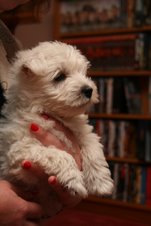
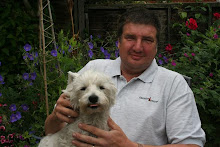
Minutes later I was on to the next job, taking the dogs out for a comfort stop and romp off the leads in the orchard. I came indoors from the bird-wrangling, grabbed the three leads (dogs are still on leads in the garden because they can not be trusted not to vanish through a hedge) and collared the dogs, before stepping out through the front door, pulled enthusiastically by three westies who couldn't wait to get outside.
That's when we saw the fox. It was only a small young one, not much bigger than a large cat - in fact I first thought it was Blue picking up some gingery low-sun rays. It quickly 'became' the fox. It was in our 'woods' not 50 yards from the front door but seeing us, it shot off down the woods, on down the drive and then nipped through a hole in the hedge to the right of our gate. I was as surprised as he was (but I think he was more scared!). We've not actually seen a fox on the premises before though we know they are about. The dogs regularly get all 'prey focused' on after-dark patrols, swapping their usual aimless meanderings for pulling in one direction, snapping, snarling and nearly choking themselves on the leads in their rush to 'get at' some noise, smell or sight which is lost on me. We know that our first hen was taken by a fox way back, before William was on the scene, and neighbours regularly warn us about our free ranging preferences.
So I did some extra patrols, letting the dogs have a good sniff and scent mark on Mr Fox's trail, I blocked up the coop door with an extra big log, double checked the rabbits, we made sure the cats were both indoors last night and I checked out my poultry discussion website for advice. They advise contacting the local gun club where someone might be willing to stake the place out in the hope of 'getting' him on a return visit. Finally, obviously, I have abandoned the idea of late nights on the tiles for birdies. They will be rounded up pre supper despite their protestations. Most of the chooks actually roost 7 feet up on the top perch, so might have been alright anyway, but we currently have Broody Betty down at ground level sitting on her eggs, and the geese are ground-roosters. He was only a small fox, so might have been nervous of taking on our geese, especially in the breeding season, but he'd not have thought twice about making off with our broody, which would have been especially heart breaking so close to our potential hatching day.
Too close for comfort, Mr Fox. You are not welcome here. Stay away!
Tuesday, 23 April 2013

Monday, 22 April 2013
"Newt Bothering"
Being ardent wildlife gardeners and natural history enthusiasts we do quite like to get involved in local moves to enhance the environment and hence our volunteering to plant some trees towards the 'Plant a Million Trees in a Day' project happening this weekend (assuming the trees get delivered; we are only 5 days out now and no ETA for them at this stage). When Liz heard a call go out on local radio for volunteers to become newt surveyors in County Roscommon, she was in there like Flynn.
 The Irish Wildlife Trust do not have the breadth of knowledge on distribution and habits for Irish amphibian species that the equivalent group would have in the UK (although there have been some studies done) so they are still at the stage of confirming distribution of some species, and amphibians being among these.
Their current belief is that there is only one native species of newt in Ireland, the Smooth Newt although there may be an escaped/introduced population of Alpine Newts in Galway. They also believe that there are no Common Toads, and only (widespread) Common Frog and (some) Natterjack Toads in Kerry. I actually think I have seen a toad here, under some plastic sheeting I'd put down as weed suppressant on the allotment, but Liz's Man-at-IWT says it would be 'very exciting' and would need photographic or physical evidence before he was convinced.
Stranger things have happened mind. In the UK, dormouse 'knowledge' was largely based on people re-hashing old books which were already rehashes of even older books. Everyone "knew" that you only got dormice in broad leaved woodland where they needed honeysuckle to bark-strip to build nests. Then we started surveying all around the South East including our own Challock Forest in Ashford and found thriving populations in stands of, for example, Corsican Pine, with nests made from grass and leaves. The 'books' are now being re-written with modern information. That is the plan by IWT for their own species and hence this attempt to recruit a surveyor for every 10 km square of Ireland.
Liz went 'back to school' armed with notebook and pen, attending a session at the Ardcarne Garden Centre yesterday afternoon. She is now an embryonic expert on all things Smooth Newt, distribution, site selection, surveying methods and reporting. Amusingly, as the training session came to the section where trainees would be shown live newts in what the trainer assumed would be a decent sized pond (Ardcarne had told him they had newts) he asked to be shown the pond. He was a bit surprised to be told by the Ardcarne lady that there was, in fact, no pond, only the pools they use to store aquatic plants for sale, and the newts were in those!. The training guy rather disbelievingly went to check with some of the course members so that the latter could 'see the newt in question'. There were indeed newts and the guy was able to tick off that 10 km square on his map but was left wondering how they got there!
 Liz came away with a wad of training materials in a posh folder and her own copious notes in the notebook. She will now wait till the training guy (Seán Meehan) contacts her to confirm which 10 km square we 'own' (we are hoping it is this one, where we live, as we can then nip down to John Deere Bob's likely pond down by Lough Feigh itself which looks very promising - if J-M and Em-J Silverwood are reading this, it's the one you guys tried to wade across with John the Bass Player last Summer). We then have to go and do our simple 'Presence or absence' survey a couple of times this year and report back.
As is her wont, Liz has called this activity 'Newt Bothering' and hence my subject header. Lissotriton vulgaris here we come. We have seen newts here on this land, too, especially last year when we were clearing lush, overgrown vegetation and found the species among the grass. We are now a bit more mowed, 'manicured' and short-grass, especially since the advent of sheep and now geese, but we are hoping that the new pond, once finished will be rapidly colonized by newts, frogs and (if that really WAS a toad) toads, too. That'll show 'em!

Their current belief is that there is only one native species of newt in Ireland, the Smooth Newt although there may be an escaped/introduced population of Alpine Newts in Galway. They also believe that there are no Common Toads, and only (widespread) Common Frog and (some) Natterjack Toads in Kerry. I actually think I have seen a toad here, under some plastic sheeting I'd put down as weed suppressant on the allotment, but Liz's Man-at-IWT says it would be 'very exciting' and would need photographic or physical evidence before he was convinced.
Stranger things have happened mind. In the UK, dormouse 'knowledge' was largely based on people re-hashing old books which were already rehashes of even older books. Everyone "knew" that you only got dormice in broad leaved woodland where they needed honeysuckle to bark-strip to build nests. Then we started surveying all around the South East including our own Challock Forest in Ashford and found thriving populations in stands of, for example, Corsican Pine, with nests made from grass and leaves. The 'books' are now being re-written with modern information. That is the plan by IWT for their own species and hence this attempt to recruit a surveyor for every 10 km square of Ireland.
Liz went 'back to school' armed with notebook and pen, attending a session at the Ardcarne Garden Centre yesterday afternoon. She is now an embryonic expert on all things Smooth Newt, distribution, site selection, surveying methods and reporting. Amusingly, as the training session came to the section where trainees would be shown live newts in what the trainer assumed would be a decent sized pond (Ardcarne had told him they had newts) he asked to be shown the pond. He was a bit surprised to be told by the Ardcarne lady that there was, in fact, no pond, only the pools they use to store aquatic plants for sale, and the newts were in those!. The training guy rather disbelievingly went to check with some of the course members so that the latter could 'see the newt in question'. There were indeed newts and the guy was able to tick off that 10 km square on his map but was left wondering how they got there!

As is her wont, Liz has called this activity 'Newt Bothering' and hence my subject header. Lissotriton vulgaris here we come. We have seen newts here on this land, too, especially last year when we were clearing lush, overgrown vegetation and found the species among the grass. We are now a bit more mowed, 'manicured' and short-grass, especially since the advent of sheep and now geese, but we are hoping that the new pond, once finished will be rapidly colonized by newts, frogs and (if that really WAS a toad) toads, too. That'll show 'em!
Sunday, 21 April 2013
Moving up a Gear


Friday, 19 April 2013
A Complete Change


In terms of geese, our egg laying bird(s) are continuing to build up a clutch. There were, when I looked this morning, 7 eggs in a neat well in the hay-box, carefully covered with hay so as to be invisible from above. Curiously this clutch does not seem to increase by one egg a day but, rather, by 2 eggs at once every other day. This took us a bit by surprise but is obviously because we actually have 2 geese a-laying and they are taking turns in the hay box. This might, of course, end in tears when they both decide there are enough eggs and have an argument over who gets to broody.


John Deere Bob invited me to come collect some more calf poo but asked could I load it myself. Of course, I was delighted to and zoomed down there on the bike. Bob basically handed me the tractor keys and left me to it, doing my own loading, driving, tipping back here and then cleaning out the 'shepherd's box' on the tractor at the end. Many thanks, Bob. Readers will know that I will have enjoyed playing on the tractor as much as I appreciate now having the poo. We boys never grow up. The toys just get bigger!


Tuesday, 16 April 2013
Concealed Shoes
Well! You live and learn! Today a fascinating story about a subject of which we had no idea till today. Hiding shoes in buildings, in walls, up chimneys and so on as a lucky charm, historically. It's a well known 'thing' apparently, but had passed us by.
 The mighty winds of Sunday night and Monday, we discovered to our horror, had slightly lifted the Tígín roof in presumably a particularly strong gust. All these old buildings are not particularly well put together and the roof of this one must be a good 30-40 years old so that the timbers are quite rotten and the tin fairly rusty. The concrete and stone walls are solid enough to the top (gutter height) but the roof is then put on, seemingly without it being fixed down. The angle under the lower ends of each strip of corrugated, seems to be loosely filled with rubble before loose concrete is thrown into the gap from inside the building presumably to try to hold the loose rubble together and maybe 'glue' down the lowest horizontal as some kind of attempted 'wall plate'. The roof is then held down by pouring concrete over the ends of the roof at the gables, first creating a wooden box of shuttering to take the concrete while it sets.
 Our winds had lifted the 'wall plate' half way along the wall and a loose stone had rolled into the gap, preventing the roof from falling back into place when the gust finished. We spotted that the corrugated seemed to be well proud of the guttering. The 'repair' was fairly simple, I just had to poke the loose stone back up out of the way and the roof could sag back onto its wall BUT it as in doing this poking, I spotted a small child's boot up among the rubble on top of the wall.
The shoe is 6 and three quarters inches long and 2 and three quarters inches wide and is of obviously 'stout' agricultural construction with several layers of leather, and most of its nails still there but blown and rusty. Fascinated, I winkled it out to show Liz, but we both then had the horrors in case this was some kind of family bereavement / memorial thing and decided not to use this in this blog or to photograph it.
 However, Liz then went a-Googling on the internet using "Shoes found in walls" in the search engine and quickly discovered that this is actually a well known and wide spread cultural and building trades thing, to conceal a single child's-size shoe in your building works as a good luck token and there are whole museum databases and sections on which to record your finds. Northampton Museum in the UK and The Irish National Museum both ask for details.
One website at
http://northamptonmuseums.wordpress.com/2012/06/19/concealed-shoes/
had more.


The shoe is 6 and three quarters inches long and 2 and three quarters inches wide and is of obviously 'stout' agricultural construction with several layers of leather, and most of its nails still there but blown and rusty. Fascinated, I winkled it out to show Liz, but we both then had the horrors in case this was some kind of family bereavement / memorial thing and decided not to use this in this blog or to photograph it.

One website at
http://northamptonmuseums.wordpress.com/2012/06/19/concealed-shoes/
had more.
- "People often hid old boots and shoes," they report, "in chimneys and walls to bring good luck to their houses and to ward off evil spirits.
- The shoes are always worn out.
- Very often there is only one shoe.
- Many of the shoes are for children.
- The shoes were often put in place when building work was being done to the house.
- It may be that if the workmen found a shoe they replaced it with a new offering, or put the old shoe back together with a new one?
- No one knows when and how this habit began.
- The earliest shoes we know of were put in place about 1500.
- Shoes seem to have had a special significance.
- A shoe is the only item of clothing which takes on the shape of the person wearing it.
- A single worn shoe was hidden so that a malevolent spirit could not steal it and take away the protection the shoe gave.
Today people renovating old buildings sometimes come across ‘concealed shoes’. The finds are very important because they show us what ordinary people were wearing on their feet hundreds of years ago.
We keep a concealed shoe index here at the museum
At the moment the index stands at approximately 1,900 entries from all over the U.K and also records concealed shoe finds in North America, Canada, and a number of countries in Europe including France, Spain and Poland".
We will report our shoe to both Museums and have carefully replaced it in the top of the wall.

Interestingly, this is not the first leather item I have found, so I wonder whether this is a more general farm 'thing'. In the chicken house roof I found stashed a leather over-reach boot. These boots are fitted to horses' rear hooves where the horse has a tendency to bring his back foot so far forward in his stride that it can clout his front leg, which can be a problem on shod horses.
Also, by coincidence, I was walking the dogs today and was greeted by a near-neighbour in a van who I had not met before. He introduced himself (We'll call him Brian the Roofer) and we chatted away a while before he told me that he was a roofer. A ha! said I and told him my story of the poor construction, rotten timbers, loose rubble and roof trying to get airborne. I invited him to drop by in passing and take a look and give me a quote on replacing the rooves of both the Tígín and the chicken house, which we will surely need to do at some stage, all be it hopefully not THAT soon!
Sunday, 14 April 2013
56


Goose eggs (Simon told us) stay viable for quite a long time while the goose accumulates her clutch at a rate of an egg a day or every 2nd or third day, trying to amass 12-14 eggs before she will go broody and sit on the clutch. So the next morning I headed for the goose house to let them out and to rummage and delve, but was presented with an egg in full view in a lovely cup-shaped, goose sized depression in the hay in the box. There proved to be a 2nd egg under the hay, so we collected both for use in the kitchen but then resolved to see if we could manage a clutch. All this had happened over night, quietly and with no drama from the geese.
The next day (now yesterday) that all changed and we seemed to move into a new format and level of excitement. We noticed during the morning that the geese were all hanging around the goose house door and waddling in and out of the house with much honking and noise every time the three got separated (by one being inside or outside and not visible to the others). It seemed this was the first time they had ever done anything other than as a threesome - they are normally glued together as a group, find one and you found them all. This separation was obviously stressful stuff! Eventually they sorted themselves out and Goocie sat on the box of hay while Gander and Goosey took them off a small distance to graze while Gander continued to honk and shout every few minutes, as if to reassure the sitting goose that he was still around. I went off to dig pond and after a half hour or so, Goocie emerged from the house and waddled over to find the other two.
Liz and I waited till they were safely out of sight and sneaked a peek into the house. At first we thought there was no egg but, no, there was indeed and egg but so carefully hidden under hay pulled across the top that it was invisible from above. I noticed in the evening when I went to round up the geese that Goocie went into the house and straight over to the hay box where she poked about checking that the egg was still there. We hope this means that she is now in 'accumulating a clutch' mode, so we have left that egg intact and will wait and see. There were no more eggs over night or today. Anne and Simon tells us that we may need to try to separate the 2 females if they both start nesting as they can hassle each other and start interfering with each others' nests, stealing or breaking eggs etc. This might have practical problems in our set-up; we'd struggle to fence the two halves of the family apart but still give them access to all their other needs and the gander, so we are just keeping a watchful eye. We will cross those bridges when (and if) we come to them.
Happy Birthday to me. I am told it is also the anniversary of the Titanic hitting the iceberg; that happened not long before midnight on the 14th and Titanic sank on the 15th. So now you know.
Wednesday, 10 April 2013
Hearth and Home

It's so dry that all the farmers are looking to let their cattle out of the indoor yards but they daren't as there is nothing for them to eat out there. I noticed on my dog walk today that even the ferns in the ditches and hedge-bottoms along the lane have that curled, frazzled, freeze-dried look. Liz and I are both wary of praying for rain as we might bring down another year like 2012 (!) but the garden could definitely use some.


But we never quite worked out what to do with the hearth once it had all been carefully cleaned and re-hung. We weighed up a number of options involving a marble plinth and brass fenders, or simple dark tiles, but the stone was likely to be in the €200's and the fender another €250. We have sat there, indecisively, looking at the gap in the sandstone coloured floor tiles and found lots of other jobs to do instead!
Well, not any more. When helping John Deere Bob do his turf we spotted a big pile of old waste tiles including some marble-effect black floor tiles in the barn and Bob was more than happy to unload some on us, they having been gathered by one of his brothers while he was still living in the family home, where Bob now lives. He did not know where the brother had got them or why. Armed with a dozen of those and an angle grinder borrowed from Mentor Anne, and a bag of left-over floor tile adhesive, I was away and in just a few hours had created this hearth which we are both very pleased with. It looks very 'right' in our opinion, with the greener, multi-hued marble of the fireplace itself.

I have, though, discovered how the French game of 'boules' or 'petanque' came to be invented. There was this gang of rural French villagers back in the day, named Etienne, Noel, Pierre, Thierry, André and Ullyse, who sat around the village pump smoking Gauloises and taking the Micky out of the village idiot who was stone deaf. He was so deaf that when asked anything, including his name, his reply was invariably, "Quoi"? and this became his nickname. So well ingrained did the nickname become that no-one could remember his proper name. Growing bored one summer of hanging round the village pump, this bunch of lads decided to go on holiday to Ireland where their long lost Auntie Elize had started to create a small holding in the 'wesht'. The lads' Mums insisted that if they were going, then they should a) take the idiot 'Quoi' with them and b) help Elize as much as possible on the 'farm'.
Well, as it happened, the job that week was to dig a big pond (wouldn't you know it?) so the lads pitched in and started to dig across the chosen space, digging up along the way, all manner of rocks, mainly hard sandstone lumps roughly round in shape and cricket ball sized. To start with the lads piled these in a heap, knowing that Elize might use them as path edges, but as they progressed backwards across the pond, away from their pile of stones, getting stones to the pile involved an under-arm toss of ever-increasing length. Get it right and your new stone clonked nicely into the pile and stayed there. Get it wrong and your stone bounced off one of the existing stones and shot off several yards across the grass and someone had to go retrieve it. Guess who? Quoi of course!
As the distance became greater, there was a real skill in making the correct toss and the lads, being a bit sporty enjoyed the competition with each other, cheering a good throw, laughing roundly at a bad one and even keeping score. The work progressed well and the pond was dug in no time, but the lads had enjoyed the throwing game so much they decided that a sport along the same lines should exist and that they'd take it back to their village and start it there. What to call it, then? Well, suggested Elize, let's make up a word which sounds like a lump of sandstone hitting the pile of stones, but the word be made up from all our names, P for Pierre, E for Etienne, T for Thierry and so on, with a Q for Quoi, of course and an E for their dear Tante Elize.
Or does that sound like a load of 'Boules' to you?
Subscribe to:
Posts (Atom)