Showing posts with label organic. Show all posts

Friday, 21 July 2017

Dipping a Toe into 'HelpX' Waters

Hollyhock
Another slow-news week and this time I really will keep it short. In the last post, I warned the reader that I'd not much to say and then went on a medium sized epic about concrete and what not. Not this time, I'm afraid - genuinely just plodding along the old familiar paths but about to embark on a new adventure, namely hosting some volunteer labour for the price of bed and board. Yes. A big change - instead of adding to the amount of man-hours we NEED in a day, we are adding to those available. Step forward the on-line service, Help-X.

From their own website (http://www.helpx.net/) "HelpX is an on line listing of host organic farms, non-organic farms, farm-stays, home-stays, ranches, lodges, B&Bs, backpackers hostels and even sailing boats who invite volunteer helpers to stay with them short-term in exchange for food and accommodation."

Black Marans hen decides to take a turn at this broody-ing.
So on one side of this arrangement are loads of places like ours with too much to do in the day and weeds taking over the veg' gardens, buildings in need of repair or, at the right time of year, lambing, sheep shearing or any amount of other livestock tasks PLUS spare room(s) and a willingness to take in complete strangers and feed and accommodate them.

Might be man-junk and old paint tins but at least it's TIDY.
On the other side, thankfully, are an army of people whose idea of the perfect holiday or the best form of research into whether they'd like to do this job for real. They just have to get themselves to you and then do, the general rule says, around 25 hours work for you per week. The rest of the week is theirs to go touristing, shopping or what ever they fancy. They live with you as family.

The 'bird house' still needs white lime at the far end in the
goosey bit. You can just see the broody bird holding the job up.
Both sides register their existence and advertise their wares on the Help-X website, with a view to trying to attract interest from the other. We, the 'hosts' have to make our place sound and look enjoyable enough to hook some volunteers and they have to apply to us and convince us they are the kind of volunteers we'd love to have around.

Amusingly, on the website, each side can see the other's previous 14 transactions/emails so while this negotiation is going on you can tell that your applicants are also applying to many other places. It is a bit like an E-Bay auction and we 'lost' our first 2 sets of applicants and began to wonder whether these people were looking with half an eye to the 'down-time' and hitting the night life and clubs and pubs of an anticipated nearby city. Perhaps, out here in the wilderness we'd never attract anyone.

The Hubbard meat-birds half way there at 45 days
But, No! No need for pessimism. Earlier this week we got a possible 'bite' from a couple of lads from Spain. These guys had a quick conversation with Liz on the website e-mail system and have now gone as far as booking flights and asking for directions to us from the airport. I do not want to tempt fate and say too much too soon so I will stop here and promise more on this when it is really happening.

We like a decent sized "new" potato on this farm. These are just
volunteers from the compost heap.
We are very excited and planning how we will feed them and what we will put them to work on and so on. We want them to be very happy with us and very happy here as well as wanting to be delighted with them. It is our first little dip into these murky waters, though we know of several friends who have used these websites before and have a long and happy history of using the volunteers.

Messing with the sour dough starter. Every now and then you
must split it and 'discard' half. A friend suggested make a 'gallette'
pancake/crumpet to eat with butter and honey.
Some are 'Help-X' but others use the stricter ORGANIC farming service "WWOOF" (website wwoof.net - the acronym is for the Worldwide Federation of Organic blah blah Organisations but is not in English). WWOOF volunteers are known as 'Wwoofers' but we are not sufficiently organic to qualify. Our new friend Anne, working with my Sligo-based Texel sheep owning chums, is a Help-X volunteer. She is in the middle of a 6 week stint there, she is delighted with how it is going and I know that Colin and Alayne are over the moon with her.

There now! You don't get a dog's ear-'ole on
every blog, do you? Towser is now all clean
and a healthy pink. More comfortable too. 
More on this later. Oh, and if you're into this post so quick that you saw it without pictures, an apology. The camera battery went flat as I was trying to download pictures (actually at the exact second that having selected the pics I wanted and chosen the destination folder and reached for the 'Paste' button). You will just have to be patient, like me, while I charge the battery and can then get the thing to boot up again.

Purple loose-strife
Until next time, then.

Friday, 24 April 2015

Old Mother Hubbard's Class of 2015

New piggies, turkeys, the first cuckoo calling from down in the bog, swallows, eggs by the dozen, 'hins' going broody; it's all getting a definite Spring flavour round here and now, the cherry on the cake, the arrival of this year's batch of one day old baby 'Hubbard' chicks. These guys, apart from being impossibly cute at this age are a GOOD THING but readers who are a bit squeamish about the more 'awkward' side of meat production might like to skip a few paragraphs. You just carry on thinking that chicken reaches your shopping basket, created in an expanded polystyrene tray with cling film over it as if by magic.

The new chicks in the brooder. The IR lamp
substitutes for Mum's warm breast. 
This is our third year of 'growing' Hubbard chicks and they really are our favourite meat-bird for their taste and their massive rate of adding weight, which gives you a family-sized oven-ready carcass in as little as 4-5 months even in our relaxed, fully-free range system. Hubbards are a hybrid variety developed by the big commercial hatcheries and are the Republic of Ireland's 'go-to' variety for the big commercial units if they are producing 'Free Range' or 'Organic' oven ready birds for the supermarket.

As you'd expect, this means they are dealing with massive numbers - hatchery rooms good for tens or hundreds of thousands of eggs and young birds and customers turning up with articulated lorries to collect their chicks. These kind of people do not normally entertain tiny customers like us, who would want just a dozen, so Hubbards are not a big thing with the hobby, back yard and small holding type chicken-rearer. Fortunately for us, Mentor Anne and Simon, who used to be in the industry (they produced organic eggs for Supermarkets all round Connacht) still have contacts in this world and still get away with buying birds each year even though they buy on behalf of just 3 customers, themselves and 2 others (one being us).

We are delighted and very grateful each year when the call comes "Do you want some Hubbards this year - we are going up there on Wednesday?" (Thank you, A+S!) We just have to have our brooder-box ready on the day and, when we get the 'we're home' text, nip down and collect our dozen from Anne's place. Oh, and then, of course just feed them, rear them, keep them safe and then, as substitute Mum*, generally look after them for the 4-5 months. Anne and Simon have to drive all the way up to the hatchery in Co Monaghan to collect them, up near the Northern Ireland border; it was a hot sunny day and they were parched and pooped by the time they got home.

Pear blossom in the orchard.
Meanwhile all else is chugging along nicely too. The bees appear to be thriving especially in the gorgeous, blue sky warm days we have been amazed by this week. We do not want to check for that possible missing queen just yet - we are waiting at least the 9 days in which anything she had laid by April 17th (when we had the clumsiness problem) will have hatched (3 days) and been fed as a larva in an open brood-cell (6 more days) before being capped over to pupate till day 16 (worker) or 24 (drone). By Sunday (Day 9) when we might inspect, we only have to find eggs or open larvae to know that the queen survived our abuse and is still laying.

An epic batch of nice garlicky hummus (chick-pea paste)
We do not have to find the queen herself, one tiny bee in a colony of 10,000. She is very mobile, good at running for cover and keen to hide when you pull the roof off her colony and let the light in. But a healthy queen in early summer will be laying, famously, 1000-1500 eggs every day, so a quick sum will tell you that with roughly 23 standard honeycomb sized cells per square inch, she is laying a patch of new brood 43-65 square inches in size each day. I am just looking for any one of about 9 such patches in the hive. Should be able to manage that, even if we can't see Her Majesty! One factor which might delay this even more is a forecast change from the lovely sunshine to more typical rain and chilly winds; I cannot open the hive safely with the temperature below about 15ºC for risk of killing all those square inches of babies by hypothermia.

Free range or solid fuel burning range?
The new turkeys have settled quickly in brilliantly. We find them much more socialised (humanised?) and 'tame' than other new birds so we think they must have been handled frequently or had a lot of contact with people in their former home. On one occasion Liz was sitting out on the front terrace in the sun and the hen, Barbara was mooching all round her feet while the cock-bird (or 'stag'), 'Tom' started displaying at Liz just to make sure she knew he was not having her touch his 'wife'. He got so close her, he was nudging Liz's leg with his puffed up chest. On another occasion, I'd gone out walking the dogs and, it being a warm day, I'd left the front door open. Liz was cooking in the kitchen but came back in to find Barbara strolling round the house, quietly checking out the book cases, leather sofa, chairs and then the range (see picture). Liz let her get on with it and then shuffled her quietly outside as she saw me returning with the dogs.

Fritillaries possibly naturalising in the
grass of the front lawn under the trees.
The piggies too, have settled into our routine well and have been receiving visitors. One neighbour likes to turn up with her little girl after school and sometimes with friends of same. They have been visited and admired by Anne and Simon and even by K-Dub and Carolyn; K-Dub was also curious to see what the turkeys looked like up close because he might (only might, you understand!) buy a pair himself. The pigs happily trot up to the fence to receive gifts of sliced apple and are just now starting to let me touch them and scratch them behind the ears. They're in.

Aran knits. A world of "impossibly complex" patterns on a
sixteen row repeat cycle. Soccer helps, apparently.
Amelanchier canadensis (Snowy
mespilus or  'shadbush')
Meanwhile, indoors, Liz's knitting has taken a dramatic turn as she is trying out Aran patterns. When she was about to head off for her ten days of minding 'Daddy', this seemed like a brilliant idea and I will definitely love the product. Getting into it, though, sitting down with Dad while the TV burbled some Match of the Day soccer game that he was glued to, she realised how "impossibly complex" the patterns are, with their variety of cabling, 'basket weave' and other stuff on a 16-row repeat. She tells me she took 5 hours to get the first 'cycle' sorted and could not change her focus for risk of getting it wrong. Slowly, though, it all settled down and she found that the footie pundits warbling away in the background were very calming even though she has no more than a jot of interest in the game. She tells me that Dad would TRY to explain that this one was an important game because.... blahhh... blahh...relegation zone... away goals.... Burnley........blah blah burble burble zzzzzzzzzzzzzzzzzzzzz.

In the garden, all sorts of lovely flowering and blossoming is going on. We have fritillaries on the front lawn which we think have come from seed which ripened in the two seed-pods we saw last year. As with the crocus leaves and primroses, we are delighted that both the geese and sheep leave these alone. A nice Amelanchier we have had to protect behind sheep-defences now that the lawn is a sheep field, they would browse off all the new growth and blossom.

Blue being a tart.
*Longer term followers of this blog may recall that in 2013 we got extremely lucky with this and the chicks' arrival coincided with us needing to give back to Anne some ducklings which we had hatched under  our ace broody hen "Broody Betty" (sadly no longer with us). We were able to do a sneaky swap and BB was delighted with the transformation of her 5 waddling, water-loving charges into 8 loud-cheeping, willingly pecking and scratching, water-hating, chicks. You don't get that lucky very often.

Tuesday, 22 October 2013

Day 84. A Good Day to Die?

Hubbard chickens at Day 83
For our Hubbard variety chickens, tomorrow is Day 84 from hatching. In the cut and thrust, hard nosed world of commercial free-range and/or organic meat production, this would be the target slaughter date; game over. Hubbards are the variety now widely used in Ireland for this type of system produced in commercial hatcheries (in this case one up by the Northern Ireland border) in their hundreds of thousands and sold to growers as day old chicks. They are then kept in conditions which pass (maybe only just) the minimum standards of welfare and feed to earn a 'Free Range' or 'Organic' certification to produce a big breasted, broad chested, heavy looking but still tender, oven-ready carcass. Even a small amount of research will tell you that 'Free Range' here does not quite mean happy chickens scratching in the sunny farmyard; these are still fairly intensive, crowded systems in which feeding is closely controlled and, although chickens must have 'access' to the run outside, they do not necessarily get out much.

Our 'Mini-Buffs'. 2 hens or one of each?
We got our birds on August 1st (as day olds), you will recall, mainly in order to give Broody Betty something to 'mother' when we took away 'her' ducklings. We took 8 of a batch collected by Anne and Simon from the hatchery, Anne kept a further 8 and the remaining birds went to a friend of Anne's. We had, therefore, the potential for a small scale simple comparison between the groups under our three different systems. We do complete free range (they can go where they like around the 2 and a half acres and beyond) and mixed with the other birds but have, as a result, limited control over diet. Anne does organic starting off indoors but then in a large pen, separate from her other birds so they have a lot less freedom to move but she can give them generous amounts of cooked rice and potato etc. At any given date they seemed to be a quarter to a third bigger and heavier than ours and feathered up much more slowly. The third batch are even more confined and we believe would be legally 'Free Range' but not organic and, says Anne, have put on a deal of weight even more than her birds and possibly been slaughtered by now.

Pure bred Buff Orpington cockerel and hen.
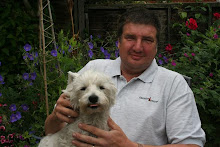
You can see from our first picture that ours look decidedly 'adolescent' and lanky rather than fat and wide-chested. Their legs look massive and out of proportion to their slim shape as if they have a lot of growing left to do. Just for the record we weighed some of them and got a weight range (live, obviously) of between 6 lb 3.25 oz (2.81 kg) and 7 lb and a quarter ounce (3.18 kg). We have decided not to slaughter any time soon. We will keep these as a living larder while they put on some more weight. Anne has warned me that because they are 'designed' (yoiks!) only to go the 84 days they may over run their 'tender' spec and become sinewy and tough, only fit for casseroles and coq-au-vin but that is not an issue for us - we LOVE a coq au vin! I know Anne is off weighing hers today or tomorrow, so it will be interesting to see how the little 'trial' went.

My 2nd and 3rd picture here are of the 8-Ball birds, now approaching 25 weeks and well into lay if they are of that persuasion. Our 'mini buffs' (some kind of bantam-y cross) turned out, we are sure, to be both hens. That is to say that we are both sure we have seen both of them being 'trodden' by roosters and I am fairly sure they are both laying eggs and neither has crowed. My uncertainty today is just seeing them both in this picture the bird on the right seems to have pink legs rather than yellow, maybe a bigger comb and wattles and a more upright tail? Doubts are creeping in!

The 2CV saga moves on one step. I managed to get my official form signed and stamped by a nice lady Guard in Castlerea Garda Station. Now I just need that mixture tweaked one last time by the boys in the garage for our real last, final, ultimate, tail-end, conclusive shot at the NCT emissions test. I have promised myself that this will be it. If it fails this time then I will take it off the road officially (on Statutory Off Road Notice (SORN)  and it can become an interesting garden feature till a better offer comes along. I may sell it. I may keep it till it is 30 years old and doesn't need an NCT. I will have run into the buffers, defeated by the system and fed up with having spent more on tests and re-tests than I have on the car.

The ex-Hastings fig cutting
A quick catch up on the gardening. This pic shows the current state of play on the ex-Hastings fig tree cutting. Grown in Faversham for a year or two in a half barrel, we decided to bring it over with us when we moved, so it was coppiced hard and root-washed. The remains lived with me at Pud Lady's in a fertilizer sack in her front garden till we moved. We planted it in the gravelly soil at the top of the front drive here but then it got driven over by a JCB laying drains. We thought we had lost it but Liz did some detective work using early photos and found it. It languished for a while, then just about managed to produce a few leaves where upon last years sheep browsed them all off and it went into winter as a bare, inch thick 'stick'. Again we were sure it was a goner. Spring came and no leaves emerged till way into June but then it suddenly put on a spurt of 3-4 small branches reaching the 18" or so you can see here. We will give it special protection through this winter. We dream of a bright future for this tree. May it do as well as it's parent which now fills most of the gap behind Pud Lady's garage and over-tops the roof gutters (OK it's a bungalow). I want to see it shading our terrace corner on the SE corner of the house, clearly visible as you come up the drive.

And finally, I know it has been a weird late season and I know these raspberries are Autumn Bliss, but I never expected to be starting to pick a decent crop on October the 22nd. They are not the sweetest raspberries, so maybe lacked sun, and they are very juicy (plenty of rain!) but I am hoping they will stay sound on the canes for just the next couple of days till Liz returns and can enjoy them with me.

Friday, 30 August 2013

Despite the Best Efforts...

Despite the best efforts of Met Éireann and of lone New Zealand writer and weather-herald, Ken Ring (http://deefer-dawg.blogspot.ie/2013/07/ok-im-ready-now.html) August has mooped past without delivering any really hot weather and delivered us to the threshold of Autumn. We can't REALLY complain; we had amazingly hot dry spells in June and July and our August has been warm even when breezy and cloudy, so it has not stopped us doing anything and the garden has cropped away and the livestock has all got on with the job.

Hubbard chicks at Day 30 stretch out in a sunny patch catching the rays
We have been fascinated to see the Hubbard chicks develop. These guys were bought as something for Broody Betty to 'mother' when we took the ducklings from her and, rather excitingly, our 8 were only part of a larger batch which ended up in 2 other destinations and would enjoy 2 other feeding and brooding regimes. It has been fun to compare 'notes' with Mentor Anne's batch - indoor brooded under a heat lamp to start with and fed organic (and GM-free) chick-crumb.

Ours were brooded by Betty, of course, and were quickly out free ranging and scratching for worms and grubs, but were fed 'ordinary' mass-produced (i.e. not organic) crumb. By 20 days they were very different. Anne's seemed to be 10 to 20% bigger than ours but still covered only in chick fluff. Ours were smaller but were well feathered up, with wings showing primary,secondary and covert feathers, with well feathered bodies and with tails. It is interesting to think about whether the active outdoor life has them cooler and quickly growing feathers, while the indoor, heat lamp version has them not needing feathers as quickly, so able to put all that protein to body weight. It would be good to know how the third batch are doing and under what regime.

Now, at 30 days, Betty's work seems to be done and she is rarely with them. She has rejoined the 'Lovely Girls' and possibly re-started laying eggs. We have found a couple of new eggs; we have not seen who is laying these yet but BB may well be credited with them. They now find their own way about without her, moving round as a reasonably tight group like the 8-Ball did and take themselves off to 'bed' all piling into one of my new nest boxes rather than perching with their 'Mother'.

Achillea
Time finally ran out for our unfortunate little under-developed gosling, Fotherington Thomas. He lost the use of his right leg and did not look at all like improving despite a week of enhancing his Vitamin B3 and giving him physio-therapy swims on the big pond. We culled him out yesterday and now that he has been put through the kitchen-preparation stage we think we know why. His poor little scrawny, thinly muscled body (he was only 790 g 'oven ready' at 3 months) was built on a frame with what looked like every structural mis-shape of skeleton he could have inherited from his wry-tailed Father. His whole spine and pelvis curved round to his bad side and his neck had a serious 'chicane' double-bend half way down. We are now convinced that our adult geese are a sibling group and not, as advertised, a breeding trio, so we have been guilty of extreme in-breeding, brother to sister(s). At least that is a mistake easily corrected - we will just use the eggs next year and not let anyone go broody. At some point we may swap out the gander for one from a different blood line. The three remaining goslings all look fine, so they may just be the lucky 3 out of the 17 eggs originally 'set', in the DNA lottery of life.

Our orchard, you will recall, is all very new and has only been 'in' a year with planting started in August last year with one or two year old whips and 'feather' trees. We intended only to let it all sit for the first year getting established. We were happy that it blossomed but were not expecting any great fruit crop this year, so we were not disappointed when little fruit set but the Victoria Plum down at the far end of the orchard has quietly been getting on with producing a couple of dozen good sized plums. These are now colouring up well and starting to feel a bit ripe. There will not be enough for jam, but we should get a few desserts out of them and maybe a few for the fruit bowl.

The vegetable garden continues to pump out a lovely selection of vegetables more than enough to keep us and all our guests going and to make a big dent in the freezer space. We will need to invest in a decent size chest freezer this year to cope with the lamb meat. I was out this morning picking a yellow builder bucket full of runner beans and climbing French beans. I have been digging new potatoes of varieties Foremost and Ratte which fortunately escaped the blight. I have not started yet on the double-length row of Sarpo Mira main crop but they have such healthy foliage I cannot believe there will not be a shed load of tubers underground. I am storing them dried a bit but unwashed, in paper sacks in which I buy seed-wheat.

You can see from the pictures that I am still very good for rainbow chard, flat leaved kale and black (Tuscan) kale and calabrese and my small, spring-sown globe artichokes are even producing tiny chokes (which we will probably not actually eat; we will let the plant build up strength and start on that next year). We started into the carrots for the coq-au-vin this week. I have also been making sure to succession-plant to ensure a continuing crop which is not anything I was particularly good at in Kent so that I have more peas and radishes about to start and young beans at the 'first true leaves' stage.

The Jerusalem artichoke plants are huge, towering, 8 foot 'trees' so we are hoping for some good yields there, the French beans keep on coming and the turnips, which we found way too bitter, have kept the rabbits very happy for weeks as a supplementary food and a nice change from grass and herbs. The crunchiness of the turnip roots will also have been good for their teeth.

As crops finish and we move into Autumn proper, I need to be thinking about over-winter crops like onion sets, broad beans and Spring cabbage. It's all go.

Monday, 10 December 2012

Ignatius G Victualler

This then is the second and final post which should be avoided by anyone who thinks the detail around slaughter and butchery of the late lambs is "too much information". If you don't want to know about such things, look away now. Normal service and happy animal stories will resume with the next post.

"Ignatius Gannon (Victualler); Beef Mutton and Lamb as in Season. None but the best quality stocked". So says his paperwork and we can vouch for the fact that Ignatius G is an excellent butcher, a small local business in Castlerea thriving and surviving despite being almost opposite the SuperValu Supermarket. He is a tall, strong bloke with brawny arms, grey hair, a white shop-coat well smeared with the expected gore and a ready smile and jokey wit. He was also very good to us 'newbies', helped us a lot through the process and answered all my myriad questions as we went along. His prices also compare very favourably with the Supermarket prices, so that, in this exercise, we have used his as our estimate of the carcass's worth even though it would have looked even better at SuperValu rates.

Readers will know that we have already had back the 'offal' last Monday (hearts, livers and kidneys) but the main carcasses have to hang for a week, so we were back today to collect the main event and 'supervise' the cutting up - we had to choose, for example, whether we wanted shoulder joints or the much more popular (locally) gigot chops. We did. You then have to choose how big to leave the 'shoulders' - how far up the rib cage do you want the 'chopping' (for shoulder chops) to come before you stay stop, and keep the rest of the shoulder intact.

Ignatius and his 'oppo' and slaughterman of 34 years, Joe set to work sawing and cleavering and in this case they agreed to bag it up as they went along as if it was meat for sale, so that we could have all the bits labelled and we could know the price per kilo of the bits (from €9/kilo for breast meat and neck, through €11 for leg, €12 for cutlets, €13.50 for shoulder and up to €17/kilo for loin chops; this comparing to €21/kilo we have seen in Supervalu. The labels also showed the final price of the bag, so for example, a shoulder might be €32.83, 'half legs' up to about €20 and bags of 4 loin chops around €7. The output from one animal was then loaded into a tough white dustbin liner so that we could work out some numbers per animal. They charge, incidentally, €30 per animal for the slaughter and butchery though we gave them a bit of a tip too for being so brilliant.

So, having completed our other shopping we headed home with the little Fiat very well loaded down with meat. We excluded all the animals from the living room and sorted all this booty out on the Dining Room table. We were able to tap all the numbers into a spreadsheet (I can hear anyone who knows me muttering "Typical!" at this point. From this we know that for example....


1) Our three girls had carcass weights of between 17 and 18.2 kg respectively
2) The total weight of meat (excluding offal) was 52.9 kg
3) The carcasses would have cost us €213, €218 and €227 over the counter, a total of €659.24
4) Our most expensive cut is a 2.56 kg shoulder at €34.56
5) A 6 foot tall, €400 freezer will just about fit three carcasses of this size (which was a relief).


In terms of finances and 'did we make a profit' the following figures might be interesting. The sheep originally, back in September, cost €80 each. They cost €44 in supplementary feed (the grass was free as we have not yet had to worry about cultivation or fertilizer!), we paid Kenny €20 diesel for haulage to the butcher and paid €100 for the slaughter and butchery, total inputs €404.

The meat was worth €659.24 as we only used Ignatius's prices (we could have quoted Supermarket prices and we could almost have said they were organic - Heaven KNOWS how much organic lamb is worth - our grass has had no chemicals applied and these ladies had no growth promoters or other unnecessary drugs, only our bought in feed was not organic, and we cannot answer for the first 5 months of their lives. We are estimating €9.75 for the 'offal' so our outputs are €668.99, so effectively we made a profit of €264.99 which makes a nice contribution to the €600 fence we had to erect around the paddock. Mentally we were depreciating this over ten years but at this rate it's more like 3 years!. Our own man hours are not charged as we had so much fun doing this. It's been a blast and a lovely bit of learning to be small holders. Yes, we had to do the sad slaughter bit at the end, but that comes with the territory and we coped OK; we know how much love, respect, care, good food and shelter had gone into these animals and we chose our butcher with care and you can't say that if you buy stuff you've not reared and kept yourself.

Thanks to everyone who had a hand in this, especially our sheep mentor, Kenny O'C (who pronounced our results as "mighty"), to our small-holdering mentors, Anne and Simon (who found us the butcher and reassured us that we were getting good growth rates) and to Ignatius and Joe, the heroes of this particular post.

So, what's for supper then? That'll be chicken and chips because we had some to use up!

Tuesday, 28 August 2012

Making New Friends

We have made some new friends locally; a small-holder couple called Anne and Simon. They live quite close. They are just a few kilometers south of the local village of Lough Glynn as we are a few kms north. Dad first 'found' Anne on an internet poultry discussion forum website and when they got chatting they realised how close they were each to Castlerea. It was Anne who suggested Mum and Dad go to Castlerea Agricultural Show where they had such an enjoyable day. Dad and Anne had swapped mobile phone numbers with a plan to text each other at the Show and maybe meet up for a burger or a coffee. In the event they nearly missed each other and met up for a quick chat and a chance to meet and put faces to names in the car-park as they were all headed home. Mum and Dad and Anne and Simon promised to invite each to look round the two small holdings.

Anne and Simon are a bit older than 'us' and have been at the small holder game far longer. This one is their 4th or 5th; they have 'done' a couple here in Ireland and then one in Galicia and one Catalonia and have now moved back to Co Roscommon, even though they are both, actually, Brits. They are both mad keen 'organic' farmers who were in at the start when the organic movement first kicked off in Ireland and Anne was a lecturer on poultry management in the Organic Centre at Rossinver, Co. Lietrim and they do a lot of the 'permaculture' stuff and sustainability techniques as well as playing with African-Aid style "Keyhole beds". They are pleasantly 'old hippy'-ish. They keep the place going despite not being in the first flush of youth or the pink of health and they have dozens of chickens in 3 main breeds (including Buffs and La Bresse) as well as 2 donkeys (just to keep the grass down!), many ducks and huge meat-rabbits. Successfully burgeoning fruit and veg are everywhere and there is a well stocked poly tunnel. They also have 9 cats and 2 aged dogs all of which they brought back from Spain with them through all the hassles of rabies control and import vetting.

Mum and Dad were invited down for a visit and a look round on Thursday 16th, arrived with a jar of our blackcurrant jam, and came away with a jar of lemon curd and 4 blackcurrant plants. They returned the visit on Thursday 23rd arriving with 6 big duck eggs for Mum and Dad. They fell in love with all we dogs and puppies and, especially, Anne loved the kittens. We were all a tiny bit anxious, as if we were going to be 'inspected' but we needn't have worried. They were delighted with the place and impressed by the amount of work which has been done to get it to where we are now, all be it we are miles 'behind' Anne and Simon in the getting-established stakes. On both visits the chatting was fascinating and Mum and Dad learned so much. We are now all firm friends and the 'cultural exchange' visits are likely to continue into the future. Next stop is for Dad to take our lady rabbits, Ginny and Padfoot down to 'meet' their meat-breed Californian White buck, Peter. (Don't worry, Rogers is still here and his turn will come but for now he is still a bit small to be taking on the chunky girls). We hope that nature will take its course - that will happen on about the 6th September and 28-34 days later we may be in the baby bunny game.