|
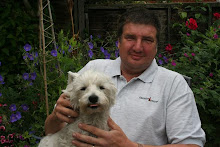
Apple shredder designed and built by woodwork
genius, K-Dub. Photo by Carolyn. |
In the last post, I described a hand-made cider apple shredding device but had no photo with which to 'paint a thousand words'. Here to put that right is the said weapon. The drum is spinning at a fair rate here so the exposed screw heads are a blur and the wooden rolling pin used to hold the more uncooperative apples down on it is also moving. I hope you can work it out.
 |
| A car load of carcasses. |
We also left the 'late' pigs down at the butcher's cooling and 'setting', hanging in his cold store. This post will show that we have been very busy ever since and not stopped with the pork products thing, till now.
 |
AB looking the part with his ADL "Cooking
up a Storm" apron and a tea-towel over his
shoulder. |
AB and I collected the meat on Thursday morning while Liz stayed home to prepare the work surfaces, for which read Dining Table and chopping boards, and to get ready the pile of plastic bags and the labelling 'Sharpie'. We use an excellent You Tube self-videoing butcher from Warwickshire for our 'how to' information. Scott Rea of the @ScottReaProject is worth a look see if you are contemplating doing any butchery or making of pork products like 'brawn' (a.k.a. 'head-cheese' ).
 |
This is very early stages, Whipping
out the "caul fat" which lines the
abdomen and is superb for suet crusts. |
Amusingly at one stage Liz was in the kitchen watching the Scott Rea on brawn while I was ensconced in the Dining Room watching the 'whole pig' one. Scott would be proud of us!
 |
| Coo. Mind your fingers there cutting out that sheet of ribs. |
So AB and I set to with the cutting with me letting him have a go on a 'monkey see, monkey do' basis. He was quickly whipping out tenderloin fillets and sheet ribs like a pro, sawing through the spine to separate out racks of chops and generally enjoying breaking those halves down into 'primal' cuts and then freeze-able portions (quarter shoulders etc).
 |
| Slicing up some bellies. |
Finished joints were landing on the table only to be rapidly bagged and labelled for the freezer. Occasionally we called Liz in to choose cuts (chops separate or in racks? shoulder in 4 quarters? ribs in sheets or separated? etc) It was a real team effort. It took around 30 to 45 minutes per half which reassured me that we were right to not spend the €50 per pig on having them cut up at the shop. We are also able to cut the chops nice and thick (basically one chop per spinal vertebra and rib), which the shop lads, with their band saws, do not do. They zip through the 'rack' every couple of cm and the saw goes diagonally through several ribs, so you get more, thinner chops but lots of sharp, diamond-shape bones in them.
 |
First fruits. Liz sorted out some small
cutlets of the new pork to go with our
lunch of left over pie and eggs. Delicious! |
By lunchtime we were done on 'our' three halves, though Liz had another full afternoon and some of the next day onwardly processing the other bits. There was liver to make into paté. She was also doing a 'rillette' ('pulled' pork preserved in soft pig fat, lovely to spread on bread!) and, with those 2 split heads, 4 lovely big tubs of brawn. AB and I had a chance for a breather before heading down to a friend's house to deliver their half carcass and to butcher it up for them at their place.
 |
Clockwise from top left. First of 4 tubs of brawn, rillette,
paté and more paté. The green in the brawn is fresh parsley. |
The late afternoon saw me mixing up 2 strengths of flavoured brine. These recipes are from the Strawbridge books and are flavoured with a lovely 'Christmassy' mix of cloves, garlic, onion, star anise, bay, mustard seed, chilli flakes, allspice and peppercorns. The big whole ham gets 3 days in the less salty/sugary brew before being frozen till December. The belly pork rectangles for bacon rashers get the stronger brew but only for 24 hours.
 |
The fridge in the Utility Room is rather
over-full, at least in the short term! Here
the two 'Parma' legs stand in dry salt mix
and the other buckets hold cuts in brine(s). |
We are also having another go at the dry-cure and air dried "Parma" style hams. 2 whole legs again with one planning to be ready in August 2018 and the other for Christmas 2018. These are rather risky investments - each leg is about €60 gone up the Swannee River if you don't get the salt cure right and the flies and maggots get a hold, but this is our 3rd year at this and we are quietly confident that our salt, sugar and spices (not to mention 16 days in the fridge!) will win the day.
 |
Out in the 'honesty box' we are struggling to keep up with
demand for eggs. The girls are on a 'Go Slow'. |
The Utility Room fridge is feeling a bit over stuffed just now. The whole legs are long, so they go in standing on end and we have to take out the shelves.
 |
If you are pinned down by the rain, you can
always break up some pallets for kindling. |
The bucket for the bellies just about slides in beside the dry-cure bucket and the big-ham brine container perches rather precariously on top of that. It is only for the 24 hours, though, then the bellies are done and on day 3 the big ham is also cured, so then the legs get some space. They get patted down with more dry salt mix each day and the brine which is drawn out of the meat by the salt is drained off, lest the water dissolve and dilute the dry cure. It's all good fun and technical stuff and, even better, it works!
Meanwhile, Stumpy the hen reaches Day 21 of her 2nd go at doing 'broody' today and, right on time, she has a hatch. I have seen at least 1 baby chick peeping out from under her skirts. Following the new system of naming chicks after your current Help-X volunteers (as in Manu1, Manu2 etc) we guess these guys should become AB1, AB2 and so on. Wish them luck.