Showing posts with label Indian Summer. Show all posts

Tuesday, 14 October 2014

Autumn Tidying

Red Kuri Squash and yellow courgette
Our amazing run of rainless, blue sky, sunny days is still managing to hang in there, though the forecast tells me that a front may nip through and interrupt this happy situation tomorrow. Let's hope only briefly. The clear skies at night though, have given us the first few frosts and crunchy grass in the morning and so, inevitably, have done for the foliage and stems of the most tender crop plants - our bountiful red kuri squash and yellow courgettes, the borlotti (runner) beans and the French and 'Gaucho' drying beans. Surprisingly, however, not the nasturtiums yet; I expect these to turn into a soggy black, stringy mess at the first whisper of frost but they are untouched so far.

'Autumn Bliss' raspberries still giving us some good two-person
dessert sized pickings
Nothing for it on these collapsed plants but to pull up and cut out the stems and foliage and to collect up any 'fruit' for storage in sheds and the polytunnel. The latter was for the drying beans both of which varieties I am not 100% convinced by despite the claims of the heritage-variety seed company we bought the seed from. They (Brown Envelope Seeds) tell me that these beans are all proven in County Cork, so should 'work' here but I think our season is just not long enough.

That lovely pink-pig scarf gift. 
Both the 'Borlotti' runners and the 'Gaucho' French-style did the growing, flowering and podding up well enough but despite our Indian Summer they have not really completed the end stage, the ripening and drying. These beans are meant to move all the moisture and goodness from the pod-skin to the bean seed, leaving the beans big and hard enclosed in a papery thin, rustling, desiccated pod by about September. You pull the pods and easily rub out the seeds  so that you can store them and further dry them as an over-winter dry ingredient in stews and so on. These pods are still fleshy, thick skinned and moist, though I can feel full bean seeds inside, so they are in the poly-tunnel on a wire frame to see will they finish the drying process away from the bines.

Pig Party. A splash of the black stuff in their wheat and
milled barley. 
The pigs came up to their 6 month Birthday on the 10th October, so we decided that they should be allowed to celebrate and finally try out some Guinness. For their lunch I replaced their usual pig-nuts (which I thought might turn to mush when the Guinness touched them) with a 50/50 mix of whole wheat and milled barley with a generous glug of the black stuff stirred into it. They were mightily impressed.

Very interested in the empty tin!
Not only did they scarf down this new food, but also they kept trying to get at the empty can just outside their fence where I'd put it down while I took some pictures. I also swear they were looking at me a bit 'old fashioned' at their supper time when the exciting new flavours were replaced back with boring old pig nuts and apples. With Autumn in the pig-keeper's world comes the annual Ministry census. We get a sheep census too, but we've only ever had a zero count to record and we've had to avoid the option where zero might mean you are no longer a sheep keeper and you would like them to close your herd account.

Pig Census form.
It was nice this time, then, to be able to record a '2' - yes we do actually HAVE pigs and we intend to keep on having them. We are not sure how this will translate next year, but probably with a try at pure-bred Berkshires, the black pigs. The supplier of this year's Tamworths (freerangepigsireland.com, which 'resolves' to a website called PiggyWiggy's) impressed us with their set-up and the quality of stock so we may go back there for more. Last year they had Berkshires on sale too, though I can find no mention of Berkshires now on the website. Ah well. We'll cross that bridge when we come to it.


Tuesday, 23 September 2014

The Céide Fields

Looking down from the Visitor Centre to Killala Bay
No point in wasting these last few sunny days of our beautiful and welcome 'Indian Summer' so we decided that if Monday 22nd turned out nice, we would finally get ourselves off to a bit of touristing, specifically the Céide Fields (locals here pronounce it "Kay-juh"). The 'Heritage Ireland' website has it that...

"Beneath the wild bog-lands of North Mayo lies the Céide Fields, the most extensive Stone Age monument in the world, consisting of field systems, dwelling areas and megalithic tombs. The stone walled fields, extending over thousands of acres are almost 6,000 years old, the oldest known in the world. They are covered by a natural blanket bog with its own unique vegetation and wildlife. The Visitor Centre has won several awards, including the Gold Medal for architecture. It is located beside some of the most spectacular cliffs and rock formations in Ireland and a viewing platform is positioned on the edge of the 110 m high cliff."

45 minutes worth of duckboard walking protects the blanket
bog from the thousands of tourist feet.
This is fascinating stuff and came highly recommended by Anne and Simon as well as 'locals', but we'd never been. This despite it being only an hour and 20 minutes drive away in the beautiful county of Mayo. We are very remiss when it comes to local tourist attractions.

Award winning architecture.
Well, our day did indeed, dawn misty but clear above, so that we knew the haze would soon burn off. John Deere Bob, though, who is a confirmed politics-man and well in with the Fine Gael party, had promised he'd be bringing Councillor Michael Creaton round door to door, canvassing for support for FG's by-election candidate, Maura Hopkins. While we waited for that caravan to trundle through I had time to quickly buzz cut the dogs for the final time this year; they can now grow shaggy through the winter.

In the event the politicos re-scheduled or changed their route, so at 11 am, with the sun beautifully up, we were free to go. Our route for this one did not use the dreaded 'sat-nav', but instead used the home-spun technology of me looking at the map book and saying "Hey! There's a road here that looks interesting - it goes round a mountain and past a lake.... do you fancy that?" and Liz saying "Sounds good to me". We nipped up by Knock Airport, then through Swinford,Foxford and Ballina,to Killala Bay and Ballycastle.

Dogs at Lough Cullin
The dogs were with us, so we were always on the look out for good dog walks; we found the first at Lough Cullin,near Foxford. This is an inland lake, one of a pair with Lough Conn connected to the sea by the River Moy and we could not see how it would be tidal, but it managed to have a sandy beach and rocks just like a bit of coast, plenty of space for doggie exercise and no other people about. It even had an apparent 'upper tide line' where something a bit like marram grass was being used to stabilise the sand bank. Curious, but good for the dogs anyway.

Unusual lighting on these seaweed-covered rocks at Killala
Loaded back up we headed for Killala Bay and another nice empty beach at Ross Strand. Readers may recall that I painted my stock trailer with a paint called 'Killala Bay Blue' and wondered whether Killala Bay could really be THAT blue. Sorry - I still can't tell you, the tide was well out and the water was brown with sediment. We had a lovely stroll down the beach with the dogs loving being off the leads (they don't get many opportunities at home) and chasing in and out of the sea. Round the ragged rocks the ragged rascals ran? Nice cliffs showing exposed sedimentary rocks and a curious old building with what looked like a ruin of a boat house with a slipway, too for us.

An old boat house (?) at Ross Strand (Killala)
By now the dogs were well exercised (as well as covered in sand) and we were sure we could get away with a quick nip into the Céide Fields Visitor Centre. It wasn't hot (it had clouded over by now) and we left car windows part open; not ideal but we got away with it. Céide is a fascinating site and we surely did not do it justice; we are determined to return dog-less so that we can watch the audio-visual displays film and do the guided tour. The display materials in the centre were rather simplistic, presumably for children or tourists who have no idea about bog-land and Irish history, perhaps the film and tour will give us a bit more of the science and the archaeological explorations which are still continuing.

A sustaining lamb stew and dumplings to restore us.
All in all, we had a lovely day and we are glad we sneaked it in on the Monday, because that Indian Summer has now collapsed on us as forecast, with today being a proper autumn day with 10/10 cloud, a chilly breeze and even some splattering rain. We have retreated indoors to enjoy winter-warmer style foods and the chickens are taking themselves off to bed at 6:30 pm instead of the 7:30 they were doing on the sunny evenings. Every thing is wet again, though only enough to lay the dust at present.

Anne tells me that August was a record breaking wet month but that September had been rainless for nearly enough days to be officially a drought. Met Éireann's says that 'Absolute drought' is defined by 15 consecutive days where rainfall is less than 0.1 mm at rainfall measuring stations. We have surely had that by now.

Wednesday, 17 September 2014

Ivy

Buff Orpington youngsters go free range at 6 weeks
We are still very much enjoying the unseasonable warmth and sunshine of this 'Indian Summer' but we know that the year is on the change, leaves are starting to turn colour and fall and the garden is a lot about seed heads rather than new flowers. For the bees, though, the most important season of their year is just about to start; the ivy flowering season. Not many people outside of bee keeping know that 'our' Irish dark bees (Apis mellifera mellifera), sometimes also known as 'black bees' or 'Buckfast bees' show a behaviour unique to the subspecies, that of keeping brood (i.e. larvae) alive all through the winter months.

Ivy flowers almost open
Our bees in summer are like any other type, with the colony made up largely of a succession of fairly short lived worker females, each lasting about 6 weeks but capable of 'rearing' in that time, an average of 3 younger 'sisters', so that the colony can rapidly expand in spring up to the 20-30,000 population typical in a late summer Irish hive. Come September, though, there is a significant change with the larvae being produced being physiologically quite different. The winter workers can live up to 6 months and can lay down fat in their bodies in autumn to see them through as the honey and pollen stores start to dwindle.

Ivy covered old farm house.
These workers shrink the colony down from 30,000 bees till it can be massed in a dense, football sized 'winter cluster' in the middle of the hive, with the queen and some brood kept warm at the centre of the football by the warmth generated by bee bodies. Bees do not hibernate as such, though they do go quiet and do not leave the hive unless outdoor temperatures are over ten degrees or so.

More ivy than ash. A well covered tree
As is the way in these 'co-evolution' set ups, the plant partner to all this is the ivy which not only flowers this late in the year (starting about now) but also has pollen which is uniquely very high in fats and oils giving the Irish bees what they need. Ivy is very very common here, growing in ditches and hedge bottoms, covering walls and abandoned farmhouses, climbing high up into the canopy of big ash trees and way up trunks of the big spruces. It even commonly climbs all the way up telegraph poles leaving them completely encased in a shaggy blanket of foliage as if they themselves were some kind of bizarre palm tree. It is a real saviour for the bees as long as the weather stays warm enough for them to forage through the flowering season. I have not seen any flowers actually open yet but it cannot be long. We have high hopes.

Ivy on Black Spruce
With me back from the UK and the Buff Orpington youngsters now making 6 weeks, we have let them out free range. They love the access to the grass (which probably could do with a mow!)  but do not yet go far, hanging around by the home run and the house end of the big pond. They know the two-tone whistle and the tap of a plastic beaker full of growers pellets and come sprinting over to get fed at meal times and they take themselves off back to their familiar (rabbit) run as it starts to get dark, ready to be shut up for the night, safe from Mr Fox. We fancy that they are starting to show the enlarged combs in the possible cock birds and we are fairly sure we have at least 4 'boys' in the dozen. It will be nice if it is no more than that; 8 hens to add to the laying population!

Fodder beet for the pigs
The pigs, meanwhile, have been enjoying some fodder beet I grew for exactly that purpose. This was a new crop for me but I have done OK with it. The seed was pelletized with a fungicide and an insecticide (oops) and was a bit variable in germination, so I have gappy rows and a lot of variation in size. Some, though, are good weights and when tasted, raw, are quite sweet, like an over-sweet carrot. The pigs approve and grunt with delight as they chow down, taking either complete half beets which they carry around so that the other sister does not get any, or eating them pre-chopped into wedges.

Mapp and a chunk of Fodder Beet
Having had my turn at 'holidays', I am now taking my turn and looking after the place 'solo' as Liz took the call yesterday to say that the expected house move by the parents from Dublin down to nearer the Silverwoods was suddenly all go for THIS WEEK, today in fact! She hurriedly packed a bag and her 'Kim and Aggie' cleaning basket and jumped in the car, her job being to help with the last of the packing up in Dublin, then blitz the 'old' house ready for the buyers. This will be followed by a hike down to Silverwood-land (My ol' man, said foller the van?) to help clean up and then unpack enough stuff that Mum and Dad can move in. She's going to a tired little scullery-maid by the time Mum's done with her! Poor Liz. She was so looking forward to getting a lie-in once I was back. She only managed the one!

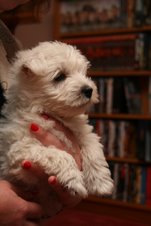
Finally, a Happy Birthday to my UK-born Westie girl, Deefer-dog who gave her name to this blog (and started it?). She is 8 years old today. Many happy returns, the 'Deefs'; may you have many more and live to see the ripe old age of your predecessors, Megan (13) and Haggis (15).