|
| Buff Orpington youngsters go free range at 6 weeks |
We are still very much enjoying the unseasonable warmth and sunshine of this 'Indian Summer' but we know that the year is on the change, leaves are starting to turn colour and fall and the garden is a lot about seed heads rather than new flowers. For the bees, though, the most important season of their year is just about to start; the ivy flowering season. Not many people outside of bee keeping know that 'our' Irish dark bees (Apis mellifera mellifera), sometimes also known as 'black bees' or 'Buckfast bees' show a behaviour unique to the subspecies, that of keeping brood (i.e. larvae) alive all through the winter months.
 |
| Ivy flowers almost open |
Our bees in summer are like any other type, with the colony made up largely of a succession of fairly short lived worker females, each lasting about 6 weeks but capable of 'rearing' in that time, an average of 3 younger 'sisters', so that the colony can rapidly expand in spring up to the 20-30,000 population typical in a late summer Irish hive. Come September, though, there is a significant change with the larvae being produced being physiologically quite different. The winter workers can live up to 6 months and can lay down fat in their bodies in autumn to see them through as the honey and pollen stores start to dwindle.
 |
| Ivy covered old farm house. |
These workers shrink the colony down from 30,000 bees till it can be massed in a dense, football sized 'winter cluster' in the middle of the hive, with the queen and some brood kept warm at the centre of the football by the warmth generated by bee bodies. Bees do not hibernate as such, though they do go quiet and do not leave the hive unless outdoor temperatures are over ten degrees or so.
 |
| More ivy than ash. A well covered tree |
As is the way in these 'co-evolution' set ups, the plant partner to all this is the ivy which not only flowers this late in the year (starting about now) but also has pollen which is uniquely very high in fats and oils giving the Irish bees what they need. Ivy is very very common here, growing in ditches and hedge bottoms, covering walls and abandoned farmhouses, climbing high up into the canopy of big ash trees and way up trunks of the big spruces. It even commonly climbs all the way up telegraph poles leaving them completely encased in a shaggy blanket of foliage as if they themselves were some kind of bizarre palm tree. It is a real saviour for the bees as long as the weather stays warm enough for them to forage through the flowering season. I have not seen any flowers actually open yet but it cannot be long. We have high hopes.
 |
| Ivy on Black Spruce |
With me back from the UK and the Buff Orpington youngsters now making 6 weeks, we have let them out free range. They love the access to the grass (which probably could do with a mow!) but do not yet go far, hanging around by the home run and the house end of the big pond. They know the two-tone whistle and the tap of a plastic beaker full of growers pellets and come sprinting over to get fed at meal times and they take themselves off back to their familiar (rabbit) run as it starts to get dark, ready to be shut up for the night, safe from Mr Fox. We fancy that they are starting to show the enlarged combs in the possible cock birds and we are fairly sure we have at least 4 'boys' in the dozen. It will be nice if it is no more than that; 8 hens to add to the laying population!
 |
| Fodder beet for the pigs |
The pigs, meanwhile, have been enjoying some fodder beet I grew for exactly that purpose. This was a new crop for me but I have done OK with it. The seed was pelletized with a fungicide and an insecticide (oops) and was a bit variable in germination, so I have gappy rows and a lot of variation in size. Some, though, are good weights and when tasted, raw, are quite sweet, like an over-sweet carrot. The pigs approve and grunt with delight as they chow down, taking either complete half beets which they carry around so that the other sister does not get any, or eating them pre-chopped into wedges.
 |
| Mapp and a chunk of Fodder Beet |
Having had my turn at 'holidays', I am now taking my turn and looking after the place 'solo' as Liz took the call yesterday to say that the expected house move by the parents from Dublin down to nearer the Silverwoods was suddenly all go for THIS WEEK, today in fact! She hurriedly packed a bag and her 'Kim and Aggie' cleaning basket and jumped in the car, her job being to help with the last of the packing up in Dublin, then blitz the 'old' house ready for the buyers. This will be followed by a hike down to Silverwood-land (My ol' man, said foller the van?) to help clean up and then unpack enough stuff that Mum and Dad can move in. She's going to a tired little scullery-maid by the time Mum's done with her! Poor Liz. She was so looking forward to getting a lie-in once I was back. She only managed the one!

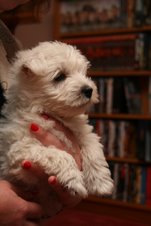
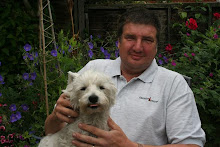
Finally, a Happy Birthday to my UK-born Westie girl, Deefer-dog who gave her name to this blog (and started it?). She is 8 years old today. Many happy returns, the 'Deefs'; may you have many more and live to see the ripe old age of your predecessors, Megan (13) and Haggis (15).